THE ENVELOPE: Agoda climbs the tower: Inside the travel giant's seven-storey Bangkok "campus"
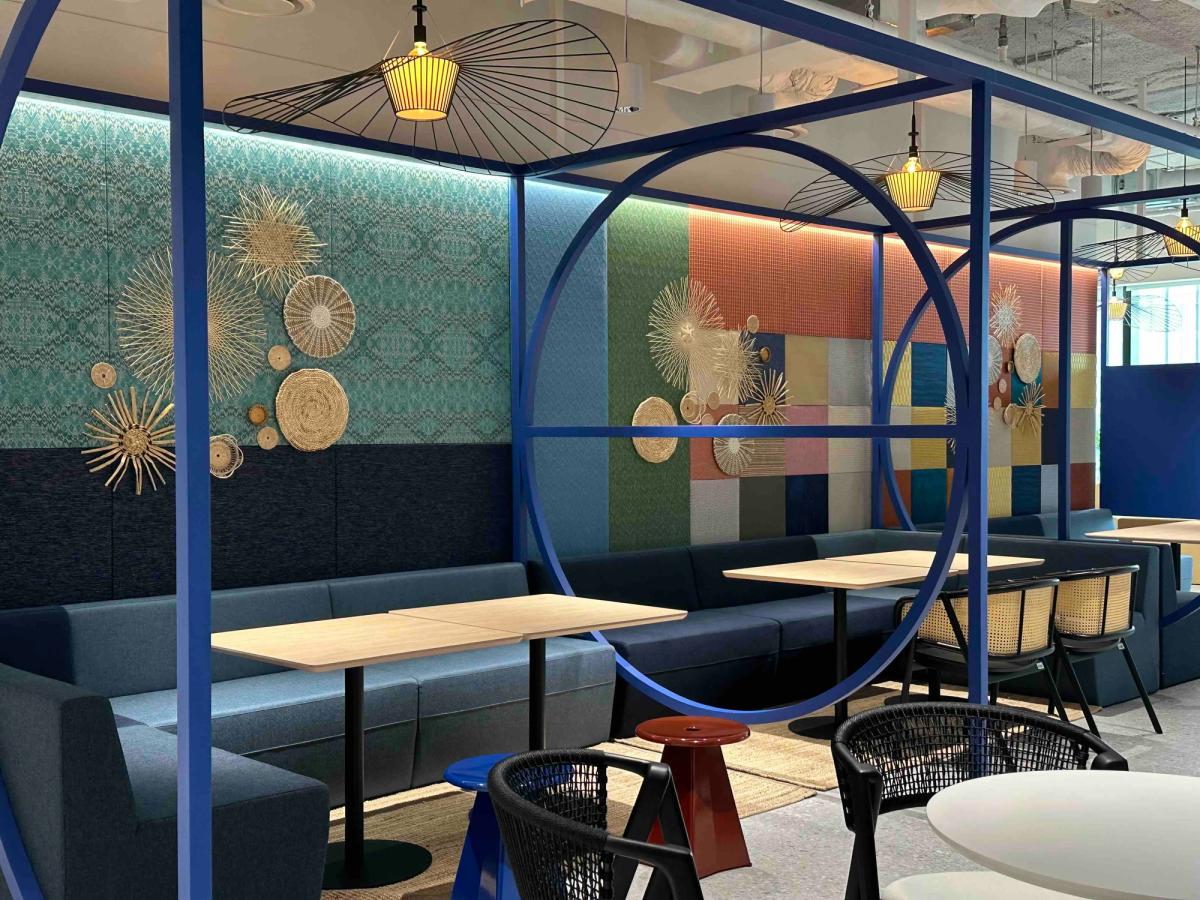
The booking platform's new Thai headquarters swaps the lift lobby for open staircases, wraps its acoustics in Jim Thompson silk, and quietly stakes a claim on Bangkok as Southeast Asia's next tech capital.
BANGKOK — There is a particular sound a corporate headquarters usually makes: the soft chime of a lift, the pause, the ascent. At Agoda's new home inside One Bangkok, that sound has been more or less designed out of existence. Across seven connected floors, the primary way to reach a colleague is to climb — the building's interior is stitched together by open staircases rather than lobbies and call buttons, a deliberate act of friction-removal disguised as circulation.
It is the clearest architectural expression of a simple brief handed to the design team: stop people from working in silos. Agoda's chief executive, Omri Morgenshtern, has spoken of the "invisible walls" of a conventional tower — the small journeys and awkward lift-waits that keep departments politely estranged. The remedy here is spatial rather than managerial. Move the stairs to the centre, and the building does the persuading for you.
The company took more than 26,000 square metres across Tower 5 of One Bangkok, the Frasers Property mega-development threading through the Pathumwan and Rama IV district. It is the largest single office Agoda operates anywhere, gathering close to 4,000 Bangkok staff — more than half its global headcount — under one roof, and it marks the platform's first relocation in over a decade, a decisive break from its long tenure near Central World. One Bangkok's outsized floor plates, among the biggest of any Grade A building in the city, are what make the "campus" conceit possible: horizontal breadth where most towers offer only vertical stacking.
At the centre of it all sits the project's social keystone, the Café Bridge — a communal heart engineered as a place everyone must pass through and few can resist lingering in. The name is not incidental. Agoda likes to describe itself as being in the business of bridging the world; here the metaphor is poured into a physical crossroads where engineers, product teams and marketers are funnelled into the same coffee queue. It is collaboration by choreography.
Sustenance, at Agoda, is decentralised. Rather than corral everyone into a single canteen, the campus scatters its appetites across seven floors, each equipped with a pantry and an adjoining "Social House" — cosy, deliberately informal enclaves stocked for the impromptu. The provisioning runs to fruit and healthy grab-and-go snacks, good coffee, and enough surface area for the occasional team potluck to break out unannounced; the idea is that nobody should have to leave the building, or even the floor, to be fed and watered. There is a pleasing circularity to it, too: some of the seating that surrounds these snack stations is upholstered in chairs made from recycled coffee grounds, so the caffeine that fuels the day is never far from the furniture it eventually becomes.
The materials palette leans local without lapsing into pastiche. Acoustic wall panels are dressed in Jim Thompson silk, the storied Thai house pressed into service as sound-absorption with a provenance. The main lobby stages a conversation between a mural by the Thai artist Kent — all Bangkok energy and street voltage — and work by the international artist Nabil, a curatorial handshake between the local and the global that neatly mirrors the company's own positioning. Individual floors take on distinct atmospheric themes, from snow mountains to tropical forest, giving the campus an internal geography you can navigate by mood.
Not that it is all soft furnishings. This is, unmistakably, a working machine for a technology company that processes travel at planetary scale. A 24/7 Network Operations Center keeps watch over the platform's systems, with an adjacent War Room built for the fast, coordinated choreography of an incident response. A 56-seat boardroom bristles with omnidirectional cameras and microphones; a professional studio and a fully soundproofed Green Room handle the content pipeline; Employee Connect kiosks dispatch IT and HR support without the ticket-queue tedium. Ergonomic desks and hot-desking flexibility complete a workplace tuned as much for wellbeing as for uptime.
Balance, in a technology company, is a design problem as much as a cultural one, and the campus treats it accordingly — threading its seven floors with rooms built expressly for stepping out of the workday. Multi-functional studios convert to yoga, pilates and fitness sessions to be slotted between meetings; wellness rooms open onto relaxation lounges where staff can book a weekly massage, among them a service staffed by visually impaired therapists carried over from the old office; and Wellness Pods are sized for a quiet nap or simply resting one's eyes, with quiet zones and phone booths absorbing anyone in search of silence. For new parents, dedicated mother's rooms are folded into a broader suite of inclusive facilities, so that the everyday logistics of returning to work are handled with discretion rather than improvised in a spare meeting room.
If the campus reads as the work of a single hand, that owes less to a headline architect than to disciplined delivery. JLL Thailand's Project & Development Services team steered the seven-floor fit-out from bare shell to working headquarters over roughly eighteen months, marshalling two contractors and a spread of stakeholders into one coherent whole — an exercise its managing director, Stephen Taylor, framed as less about size than about control, the trick being to make several floors feel like a single workplace rather than a run of disconnected rooms. The raw canvas itself came from Frasers Property's One Bangkok, the build-to-suit shell the interior was shaped around.
There is a thesis underneath all this millwork. Morgenshtern has been open about his ambition to conjure a "Silicon Valley in Bangkok," a phrase he interprets less as skyline swagger than as obligation — "Silicon Valley in Bangkok means you teach," as he puts it, framing the office as an instrument for building Thai technical talent rather than merely housing it. One Bangkok obliges the aspiration with its own credentials: roughly half the district's land given over to public green space, energy-efficient systems across the estate, and a fit-out whose furniture was sourced almost entirely from within a few hundred kilometres of the site.
The result reads as a wager placed on a city. Where a headquarters once signalled arrival, this one signals intent — a company betting that the future of travel, and a good deal of its brainpower, is best assembled in Bangkok, one flight of stairs at a time.